By Lauren Holland
Updated November 2026
RV trailer power requirements come down to one question: how much electricity does your trailer draw, and can your hookup or power station supply it? This guide shows you how to add up your loads, match them to a 30-amp or 50-amp connection, and size a battery or generator so the lights stay on and the fridge keeps cold.
Step 1: List Every Appliance and Its Wattage
Start with a written list of everything you plan to run. Look for the label on each device, usually on the back or near the power cord, which shows watts or amps at 120 volts. If only amps are listed, multiply amps by 120 to get watts. Phone chargers and LED lights are small loads, while air conditioners, electric water heaters and microwaves are the heavy hitters.
Shopping for one? See our guide: 4 Best RV Trailer Power Cords for Campers (2026).
Step 2: Check Your Hookup Amperage
Most travel trailers use a 30-amp or 50-amp plug. A 30-amp connection supplies about 3,600 watts at 120 volts, while a 50-amp connection supplies roughly 12,000 watts across two legs. Remember that campground pedestals may share a circuit, so the amperage you actually get can be lower than the plug rating. Confirm your plug type and the pedestal rating before you plan your loads.
Step 3: Calculate Your Running and Starting Loads
Add the wattage of everything you might run at the same time, then compare that total to your hookup capacity. Leave a margin of about 20 percent, because appliances draw more power when they start. An air conditioner or fridge compressor can pull two to three times its running wattage for a moment at startup.
Quick Example
Suppose you run a 13,500 BTU rooftop air conditioner, a fridge, two LED lights and a phone charger on a 30-amp hookup. The air conditioner alone can exceed what a 30-amp connection supplies once startup surge is counted, so you would run it on a 50-amp hookup or stagger it with other loads.
| Appliance | Typical Running Watts | Notes |
|---|---|---|
| Rooftop AC (13,500 BTU) | 1,300 to 1,600 | Startup surge can be much higher |
| Residential-style fridge | 150 to 300 average | Compressor cycles on and off |
| Electric water heater | 1,500 | Heating element, runs for long periods |
| Microwave | 1,000 to 1,200 | Short bursts only |
| LED lights | Under 50 total | Very low draw |
Step 4: Match Your Loads to a Power Source
Once you have a total, decide where the power comes from. Shore power handles high loads easily, while a portable power station or battery bank works best for lighter, lower-wattage use. Read What Is Shore Power RV? A Clear Guide for Campers (2026) to understand how a campground connection feeds your trailer. If you plan to run appliances from batteries, Using a Portable Power Station in an RV or Camper Van explains how to size the station for your loads.
Plan Your Power Hookup Setup
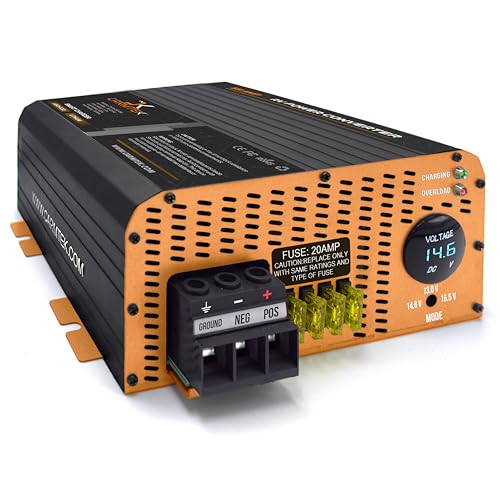
Make sure your cord, outlet and converter can handle your total load. A power converter changes 120-volt input into 12-volt power for lights and pumps, so check its output rating too. For cord selection, see Rv Power Cord 30 Amp: How to Choose and Use the Right One. If your power feels unstable, Troubleshooting RV Power Converter: A Step-by-Step Guide for Campers covers common causes.
Checklist
- Write down every appliance and its running wattage.
- Note your plug type: 30-amp or 50-amp.
- Add up loads you will run at the same time.
- Add a 20 percent margin for startup surges.
- Compare the total to your hookup or power source capacity.
Common Mistakes
- Assuming a 30-amp plug always delivers full output at every campground.
- Ignoring startup surge from air conditioners and compressors.
- Running the water heater and AC together on a 30-amp hookup.
- Forgetting that a battery bank runs out faster under high loads.
- Using a cord rated below your trailer’s amperage.
Recommended Gear
A watt meter lets you measure what each appliance actually draws, which is more reliable than label estimates. View on Amazon
A surge protector guards your trailer’s electrical system against voltage spikes at unfamiliar campground pedestals. View on Amazon
FAQ
Is a 30-amp or 50-amp hookup better for RV trailer power requirements?
A 50-amp hookup supplies far more power and is the better choice if you run air conditioning or an electric water heater. A 30-amp hookup works for smaller trailers that run mostly lights, fridge and charging.
How many watts does an RV air conditioner use?
Many rooftop units draw roughly 1,300 to 1,600 running watts, with a much higher surge at startup. Check the label on your specific unit for exact figures.
Can I run my RV on battery power alone?
You can for lights, fans and charging if your battery bank is large enough. High-wattage appliances like air conditioners drain batteries quickly, so consult a qualified RV electrician before wiring a larger system.
Conclusion
Total your appliance wattage, compare it to your hookup or battery capacity, and leave room for startup surges. Once you know your numbers, choosing the right cord, converter and power source becomes straightforward. Revisit your list whenever you add new equipment.
Ready to choose one?
About Lauren Holland
Lauren Holland is part of our editorial team and reviews and edits our off-grid power for camping, RV & vanlife guides, checking product details against manufacturer specifications and owner feedback.