 By Lauren Holland
Updated November 2026
RV air conditioner power consumption depends mostly on the unit’s rated wattage, how often its compressor cycles, and the temperature difference you are trying to create. This guide shows you how to find your air conditioner’s numbers, convert them into amps at 120 volts, and estimate how long your batteries, generator or power station can keep it running.
Step 1: Find the Nameplate Ratings
Every RV air conditioner has a nameplate or data label, usually on the side or inside the access panel. Look for the voltage, the running amps (RLA) and sometimes the locked rotor amps (LRA). Manufacturers also publish a running wattage in the owner’s manual or spec sheet.
Shopping for one? See our guide: 4 Best RV Solar Power Air Conditioners for Off-Grid Camping in 2026.
Typical rooftop units list a running draw somewhere in the range of 1,000 to 1,500 watts on a 120-volt supply, with a startup surge that can be several times higher for a fraction of a second. If your label only lists amps, multiply by the voltage to get watts.
Step 2: Convert Watts to Amps and Estimate Runtime
Use this formula to convert watts to amps at 120 volts:
Amps = Watts ÷ 120
For example, a unit drawing 1,200 watts pulls about 10 amps. To estimate runtime from a battery bank or power station, divide the usable watt-hours by the average running watts, then account for the compressor cycling off part of the time.
- Note the running watts from the nameplate or manual.
- Estimate the duty cycle. In hot weather, a compressor may run most of the hour; in mild weather it may run only a third of the time.
- Multiply running watts by duty cycle to get average watts.
- Divide the usable watt-hours of your power source by the average watts.
Step 3: Account for Startup Surge
Compressors draw a brief surge when they start. Owners often report that a portable power station or inverter shuts down on startup even though the running wattage is within its rating. Check the surge rating of your inverter or generator, not just the continuous rating, before you plug in. A soft-start kit can reduce the surge for many units.
Step 4: Match Your Power Source to the Load
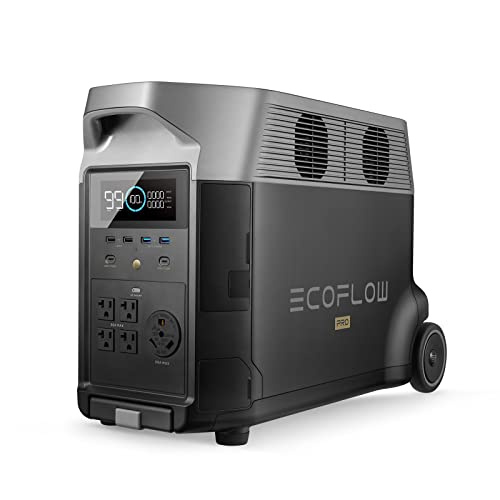
Once you know the average watts and the surge, compare them to your setup. A power station needs enough capacity for the runtime you want, and an inverter needs both continuous and surge headroom. For sizing details, see Portable Power Station for RV Air Conditioner: Sizing Guide (2026) and Power Inverter for RV Air Conditioner: How to Size It and Run It (2026). If you plan to run from a generator, What Size Generator to Power RV AC: A Step-by-Step Guide (2026) walks through the numbers.
Power Use at a Glance
| Item | Where to Find It | Why It Matters |
|---|---|---|
| Running watts | Nameplate or spec sheet | Sets average load |
| Running amps | Nameplate (RLA) | Checks wiring and breaker size |
| Startup surge | Nameplate (LRA) or manual | Determines inverter or generator size |
| Duty cycle | Estimate from conditions | Converts running watts into average use |
Common Mistakes
- Sizing only to the running watts and ignoring startup surge.
- Assuming the compressor runs continuously. Thermostat settings and shade reduce duty cycle.
- Confusing a power station’s rated capacity in watt-hours with its output in watts.
- Running the air conditioner alongside other large loads such as a microwave or water heater.
- Forgetting that fans and the blower also draw power, which adds to the total.
Recommended Gear
A soft-start device reduces the compressor’s startup surge, which can make a smaller inverter or power station workable. View on Amazon
A clamp meter lets you measure the actual running amps of your unit instead of relying only on the label. View on Amazon
A plug-in watt meter helps you check real-world draw on a standard outlet. View on Amazon
FAQ
How many watts does an RV air conditioner use?
Most rooftop units list a running draw roughly between 1,000 and 1,500 watts on 120 volts. Check your unit’s nameplate for the exact figure, since it varies by model and size.
How many amps does an RV air conditioner draw?
Divide the running watts by 120 volts to get amps. A 1,200-watt unit draws about 10 amps while running.
How long can a power station run an RV air conditioner?
Runtime depends on the usable watt-hours, the average watts after duty cycle, and ambient temperature. Calculate it using the steps above, and consult the power station manufacturer’s guidance for safe limits.
Conclusion
RV air conditioner power consumption comes down to three numbers: running watts, startup surge and duty cycle. Read them from your nameplate, convert to amps and average watts, and compare them to your power source. Check the manufacturer’s documentation before connecting any unit to an inverter, generator or battery system.
Related reading
Ready to choose one?
About Lauren Holland
Lauren Holland is part of our editorial team and reviews and edits our off-grid power for camping, RV & vanlife guides, checking product details against manufacturer specifications and owner feedback.