By Lauren Holland
Updated November 2026
Yes, you can hook up an RV to house power, but only through a standard 120V household outlet and only if you respect the limits of that circuit. Most RVs will draw more than a typical household outlet can safely supply once the air conditioner, water heater and converter all run together. Start with a dedicated outlet, a heavy-duty extension cord rated for the load, and a plan for which appliances stay off.
Why House Power Works Differently Than a Campground Pedestal
A campground pedestal usually delivers 30 or 50 amps at 120/240V, which an RV’s electrical system is designed to receive. A household outlet is a 15 or 20 amp, 120V circuit shared with the rest of the house. That gap is the core problem. Your RV’s converter and battery charger will pull current whether or not you are using lights, so the first thing to do is understand what you are feeding it. We also found How to Connect RV to House Power: 5 Best Adapters and Splitters (2026) useful on this point.
Shopping for one? See our guide: 3 Best RV Power Hook Up Kits for Campers (2026).
Factors That Decide Whether It Is Safe
- Circuit rating: A 15 amp circuit handles roughly 1,800 watts continuous. A 20 amp circuit handles about 2,400 watts. Keep total load at or below 80 percent of that figure for sustained use.
- Cord gauge and length: Long, thin cords cause voltage drop and heat. Owners often report melted plugs when using 16 gauge cords for RV loads. Use 12 gauge or heavier and keep the run short.
- Appliance draw: Air conditioners and electric water heaters are the biggest offenders. Check the nameplate amperage before you plug in.
- Shared circuits: Make sure no other heavy appliances, such as a refrigerator or microwave, are on the same breaker.
What to Do Before You Plug In
- Identify the breaker serving the outlet and confirm its amp rating.
- Turn off the RV’s air conditioner, electric water heater and any space heaters.
- Use a heavy-duty outdoor-rated cord, 12 gauge or better, and keep it as short as practical.
- Plug into a GFCI-protected outlet where possible, and inspect the plug and receptacle for heat discoloration.
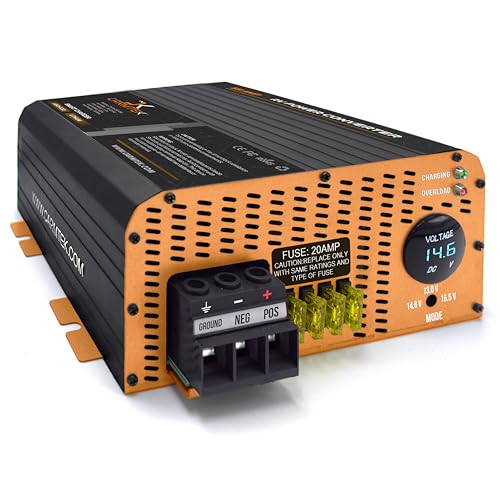
- Check the RV’s converter and power management settings so the charger draws less current on a weak supply.
- Watch for warm plugs or flickering lights, and unplug immediately if either appears.
What We’d Use
A surge protector designed for RVs helps guard against voltage spikes and brownouts from unstable household wiring. Look at the Southwire Surge Guard RV Power Protection, which is designed for RV shore power connections. View on Amazon
A heavy-duty 12 gauge outdoor extension cord keeps voltage drop and heat down compared with lighter cords. Search for a 12 gauge 25 foot RV extension cord with a 15 amp rating. View on Amazon
FAQ
Can I run my RV air conditioner on a household outlet?
Generally no. Most RV air conditioners draw more current than a standard 15 or 20 amp household circuit can supply continuously. Running one on house power often trips breakers or overheats cords.
Is a 15 amp or 20 amp outlet better for RV use?
A 20 amp outlet gives more headroom, but both are limited. Stick to light loads such as the converter, lights and a small fridge, and avoid high-draw appliances.
Should I hire an electrician before hooking up?
If your outlet looks damaged, runs hot, or you are unsure of the wiring, consult a licensed electrician before using it for RV power.
Related reading
- How to Hook Up Power Inverter to Car Battery: A Safe Step-by-Step Guide
- Wind Power for RV: 6 Best Turbine Kits for Campers (2026)
- What Is Shore Power RV? A Clear Guide for Campers (2026)
- What Does a Power Inverter Do on an RV? A Plain-English Guide
- VEVOR RV Power Outlet Box: How to Choose and Install One (2026)
- Using a Portable Power Station in an RV or Camper Van
Ready to choose one?
About Lauren Holland
Lauren Holland is part of our editorial team and reviews and edits our off-grid power for camping, RV & vanlife guides, checking product details against manufacturer specifications and owner feedback.