By Lauren Holland
Updated November 2026
An RV battery that reads charged but powers nothing is usually a problem between the battery and the appliances, not the battery itself. This guide walks you through the checks that find the break, from a quick voltage test to inspecting fuses, cables and the battery disconnect. Most fixes take less than an hour and need only a multimeter and basic hand tools.
Confirm the Battery Is Actually Delivering Voltage
A reading on a battery monitor does not always mean the battery can supply current. Set a multimeter to DC volts and test directly across the battery terminals with the loads switched on. A healthy 12V lead-acid battery typically reads about 12.4 to 12.7 volts at rest and should not drop far below 12 volts under load. A large drop when you turn something on points to a weak battery or a bad connection.
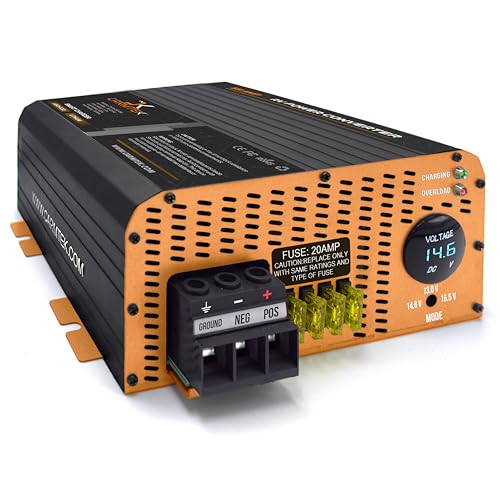
Shopping for one? See our guide: 6 Best RV Power Converters for Lithium Batteries Compared (2026).
Check the Main Fuses and Breakers
Most RVs have a main DC fuse or breaker near the battery and separate fuses on the fuse panel. A blown main fuse cuts power to the whole coach while the battery still shows a charge. Pull each fuse and test it for continuity, or look for a broken filament or a darkened window. Replace any blown fuse with one of the same amperage rating. Never install a higher-rated fuse to stop it blowing, since that defeats the wire protection.
Inspect the Battery Disconnect and Cable Connections
Many campers have a battery disconnect switch, and it is easy to leave it off. Confirm it is in the on position. Then check the battery terminals and cable lugs for corrosion, looseness or a cracked cable. Corrosion acts like an insulator and can cut the circuit even when the battery is full. Clean terminals with a wire brush and a baking soda and water solution, rinse, dry, and tighten the clamps firmly.
Quick Troubleshooting Checklist
- Measure battery voltage with the load on and note any large drop.
- Check the main battery fuse or breaker.
- Check the fuse panel for each affected circuit.
- Confirm the battery disconnect switch is on.
- Inspect and clean terminals and cable lugs; tighten all connections.
- Test the inverter or converter, if your appliances run on that circuit.
Test the Converter, Inverter and Shore Power Path
If your lights and appliances run off the 12V system through a converter, a failed converter can leave the battery full but the coach dead. Check that the converter’s output light is on and measure the output voltage at the fuse panel. For 120V appliances, confirm the inverter is switched on and that its low-voltage alarm is not active. If the problem appears only when plugged into shore power, the converter or charger is the likely culprit rather than the battery.
Recognize When the Battery Itself Has Failed
A battery can show a surface charge that looks healthy but collapses as soon as it is loaded. If it passes all the connection checks yet voltage plunges under a small load, the battery has likely lost capacity or sulfated. Owners of lead-acid batteries often find that deep discharges shorten life considerably. Have it load-tested at an auto parts store or by a qualified RV technician before buying a replacement.
Common Mistakes
- Trusting the battery monitor percentage without checking voltage under load.
- Replacing a blown fuse with a higher amperage one.
- Overlooking a battery disconnect switch that was switched off.
- Ignoring green or white corrosion on terminals, which looks minor but blocks current.
- Assuming the battery is dead when the converter or inverter is the failed part.
Recommended Gear
- A digital multimeter lets you measure DC voltage at the battery and fuse panel, which pinpoints where power stops. View on Amazon
- A battery terminal cleaning brush removes corrosion so the clamps make solid contact. View on Amazon
- An automotive fuse assortment kit lets you replace a blown RV fuse on the spot. View on Amazon
FAQ
Why does my RV battery show full but the lights won’t turn on?
A full reading only tells you the battery holds a charge, not that current reaches the lights. A blown fuse, an open battery disconnect or a failed converter can cut power to the lights while the battery stays full.
How do I know if my battery is bad or just disconnected?
Measure voltage at the battery terminals with a load on. If voltage stays near 12 volts and the appliances still fail, the problem is in the wiring or fuses. If voltage collapses under load, the battery is likely weak. We also found RV Generator Running But No Power? 7 Best Fixes and Generators Compared useful on this point.
Can a dead converter drain the battery?
A failed converter can stop charging and power the coach from a battery that never recharges, leading to a deep discharge over time. If you are unsure, have a qualified RV technician test the charging system.
Conclusion
Start with voltage under load, then work through fuses, the battery disconnect, and the cable connections before suspecting the battery. Check the converter or inverter if the problem only shows on shore power or on 120V circuits. If the fixes above do not restore power, consult a qualified RV technician, especially for electrical work you are not comfortable doing yourself.
Related reading
- No Power From Battery to RV: How to Diagnose and Fix It
- RV Solar Power Basics: Panels, Controllers and Batteries
- RV Battery Not Charging on Shore Power: 6 Causes and Fixes
- No Power to RV Thermostat: How to Diagnose and Fix It (2026)
Ready to choose one?
About Lauren Holland
Lauren Holland is part of our editorial team and reviews and edits our off-grid power for camping, RV & vanlife guides, checking product details against manufacturer specifications and owner feedback.