By Lauren Holland
Updated November 2026
If you are shopping for the best RV power converters, you are probably trying to solve one of two problems: keeping your house batteries charged while plugged into shore power, or replacing a converter that has stopped working. A converter takes 120V AC from a campground pedestal or generator and turns it into regulated 12V DC for your lights, water pump, fans, and fridge controls, while also charging your batteries. The six units below were compared on amperage rating, charging stages, compatibility with common RV power centers, brand reputation, and the patterns owners tend to describe in their reviews. None of them were bench-tested by us, so treat the notes as research-based guidance rather than measured results.
Our top picks at a glance
- 1
 TOP CHOICEBest overall𝟐𝟎𝟐𝟔 𝐔𝐩𝐠𝐫𝐚𝐝𝐞 WF-9855 55 Amp Power Converter, Rv Power Converter, WF-98View on Amazon
- 2
 TOP CHOICEBest for repairsWF-8955-MBA RV Power Converter Main Board 55 Amp Fits WF-8955 WF-8900-View on Amazon
- 3
 TOP CHOICEBest for adjustable chargingWAVLINK 55 Amp RV Power Converter, 120V AC to 12V DC Battery Charger |View on Amazon
- 4
 Best budget pickWF 8955-AD 55 Amp RV Power Converter, Power Center/Battery Chargers foView on Amazon
- 5
 Best for standard 4-stage chargingRecPro 55 Amp RV Power Converter & Battery Charger | 4-Stage ChargingView on Amazon
- 6
 Best for larger battery banksRecPro 65 Amp RV Power Converter & Battery Charger | 4-Stage ChargingView on Amazon
Our Top Picks
Quick Comparison
| Product | Best for | Key feature |
|---|---|---|
| WF-9855 55 Amp Power Converter | Direct replacement in 9800 series campers | 55 amp output, 5-year warranty listed |
| WF-8955-MBA Main Board | Repairing an existing WF-8955 converter | Drop-in main board assembly |
| WAVLINK 55 Amp RV Power Converter | Owners who want to adjust charge voltage | 13V–16.5V adjustable range, 3 charging modes |
| WF 8955-AD 55 Amp RV Power Converter | Budget-minded replacements | 55 amp 120V to 12V conversion |
| RecPro 55 Amp RV Power Converter | Standard 4-stage battery charging | 4-stage charging profile |
| RecPro 65 Amp RV Power Converter | Rigs with larger battery banks | 65 amp output, 4-stage charging |
𝟐𝟎𝟐𝟔 𝐔𝐩𝐠𝐫𝐚𝐝𝐞 WF-9855 55 Amp Power Converter, Rv Power Converter, WF-9855-AD, Replace for RV Trailer Camper 9800 Series, WF-9855-AD, 55 Amp Power Converter for Rv, 5 Years Warranty
𝟐𝟎𝟐𝟔 𝐔𝐩𝐠𝐫𝐚𝐝𝐞 WF-9855 55 Amp Power Converter, Rv Power Converter, WF-9855-AD, Replace for RV Trailer Camper 9800 Series, WF-9855-AD, 55 Amp Power Converter for Rv, 5 Years Warranty
WF-9855 55 Amp Power Converter
Best for: Direct replacement in camper and trailer power centers that use the 9800 series layout.
This unit suits owners who need a like-for-like swap rather than an upgrade of the whole power center. The listing names it as a 55 amp converter with a 5-year warranty, which is longer than many replacement units offer.
Key specs
- 55 amp rated output
- 120V AC input to 12V DC output
- Replacement part number WF-9855-AD
- 5-year warranty per listing
Pros
- Clearly matched to 9800 series replacement
- Amperage rating suits most mid-size travel trailers
- Warranty length stated in the listing
Cons
- Compatibility depends on checking your existing unit’s model number
- Installation is best left to a qualified RV technician
Bottom line: A strong first choice if your current converter is a 9800 series unit and you want a direct replacement.
View on Amazon
WF-8955-MBA RV Power Converter Main Board 55 Amp Fits WF-8955 WF-8900-AD | Fits WF-8955-AD-MBA Series Converters, Parallax 7155 & 7145 Power Centers, Direct Replacement for Main Board Assembly Repair
WF-8955-MBA RV Power Converter Main Board 55 Amp Fits WF-8955 WF-8900-AD | Fits WF-8955-AD-MBA Series Converters, Parallax 7155 & 7145 Power Centers, Direct Replacement for Main Board Assembly Repair
WF-8955-MBA RV Power Converter Main Board 55 Amp
Best for: Repairing an existing WF-8955 converter by replacing only the main board.
This is a component rather than a complete converter. It suits owners whose converter housing and transformer are still sound but whose control board has failed, which is a common and far cheaper repair than full replacement.
Key specs
- Main board assembly for WF-8955 series converters
- Listed as fitting WF-8955-AD and WF-8900-AD units
- Listed compatibility with Parallax 7155 and 7145 power centers
Pros
- Lower-cost route than replacing the whole unit
- Direct replacement design per listing
- Compatibility list is specific
Cons
- Only useful if the failure is on the board, not the transformer or housing
- Requires comfort with opening a power center and working around 120V wiring
Bottom line: Best for owners with a diagnosed control-board failure on a compatible WF-8955 unit. Have a technician confirm the diagnosis first.
View on Amazon
WAVLINK 55 Amp RV Power Converter, 120V AC to 12V DC Battery Charger | 3 Smart Charging Modes, 13V-16.5V Adjustable Range, Multi-Stage Charging
WAVLINK 55 Amp RV Power Converter, 120V AC to 12V DC Battery Charger | 3 Smart Charging Modes, 13V-16.5V Adjustable Range, Multi-Stage Charging
WAVLINK 55 Amp RV Power Converter
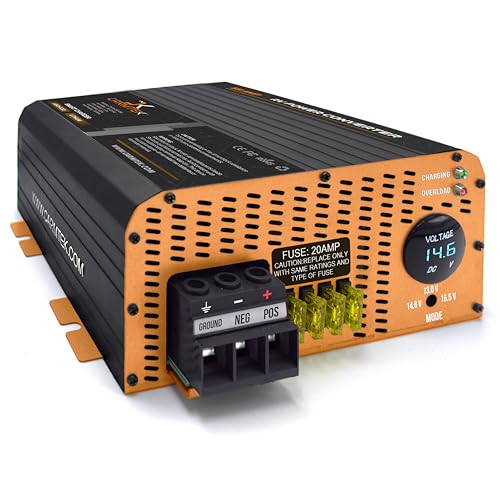
Best for: Owners who want to fine-tune charging voltage for their specific battery type.
The listing highlights an adjustable 13V to 16.5V output range and three charging modes, which gives more control than fixed-profile converters. That flexibility helps when you are matching flooded, AGM, or lithium batteries.
Key specs
- 55 amp class
- 120V AC to 12V DC
- Adjustable output 13V–16.5V
- 3 smart charging modes
- Multi-stage charging
Pros
- Adjustable voltage range is wider than typical fixed units
- Three charging modes for different battery chemistries
- Multi-stage charging listed
Cons
- Wrong voltage settings can shorten battery life, so setup requires care
- Less of a plug-in match for factory RV power centers
Bottom line: A good choice for owners who understand battery charging profiles and want adjustability.
View on Amazon
WF 8955-AD 55 Amp RV Power Converter, Power Center/Battery Chargers for rv,Camper, Trailer,rv Converter Charger,120V to 12V Camper Power Converter 55 amp
WF 8955-AD 55 Amp RV Power Converter, Power Center/Battery Chargers for rv,Camper, Trailer,rv Converter Charger,120V to 12V Camper Power Converter 55 amp
WF 8955-AD 55 Amp RV Power Converter
Best for: Budget-minded replacements in travel trailers and campers.
This unit is listed as a 55 amp power center and battery charger designed for trailers and campers. It is a practical option when the goal is restoring basic 12V function at a lower cost than premium brands.
Key specs
- 55 amp rated output
- 120V to 12V camper power converter
- Sold as a power center and battery charger
Pros
- Budget-friendly among 55 amp options
- Amperage suits common trailer loads
- Covers both power supply and battery charging roles
Cons
- Brand support and warranty details should be confirmed before buying
- Owner feedback on long-term durability varies, so inspect on arrival
Bottom line: A sensible budget pick for owners who need a working 55 amp converter and accept less brand depth.
View on Amazon
RecPro 55 Amp RV Power Converter & Battery Charger | 4-Stage Charging
RecPro 55 Amp RV Power Converter & Battery Charger | 4-Stage Charging
RecPro 55 Amp RV Power Converter & Battery Charger
Best for: Standard 4-stage battery charging in mid-size RVs.
RecPro is a recognized name in RV parts, and this unit uses a 4-stage charging profile that is the common standard for lead-acid house batteries. It suits owners who want predictable, conventional charging.
Key specs
- 55 amp rated output
- 4-stage battery charging
- 120V AC to 12V DC
Pros
- 4-stage charging suits standard deep-cycle batteries
- Brand has a broad RV parts presence
- 55 amp output fits most trailers
Cons
- Fixed charging profile offers less adjustability than programmable units
- Lithium owners may need a lithium-compatible profile
Bottom line: A dependable everyday pick for owners with standard lead-acid house batteries.
View on Amazon
RecPro 65 Amp RV Power Converter & Battery Charger | 4-Stage Charging
RecPro 65 Amp RV Power Converter & Battery Charger | 4-Stage Charging
RecPro 65 Amp RV Power Converter & Battery Charger
Best for: Rigs with larger battery banks or heavier simultaneous loads.
The 65 amp rating gives more headroom than the 55 amp version. That matters when you run a fridge, water pump, and charging at the same time on shore power, or when you are recharging a large bank quickly.
Key specs
- 65 amp rated output
- 4-stage battery charging
- 120V AC to 12V DC
Pros
- Extra amperage for heavier loads and larger battery banks
- Same 4-stage profile as the 55 amp model
- Known brand in RV parts
Cons
- Higher amp rating only helps if your wiring and breakers support it
- Fixed profile is less flexible for lithium setups
Bottom line: Choose this if your rig draws more than a 55 amp unit comfortably supplies, and your electrical system is rated for it.
View on AmazonBuying Guide
Amperage Rating
The amp rating tells you how much 12V DC current the converter can supply while also charging. Common sizes are 30, 45, 55, and 65 amps. Choose a rating that covers your largest simultaneous 12V load plus your battery charge current. A 55 amp unit gives comfortable headroom for most mid-size trailers, while larger rigs with big battery banks often benefit from 65 amps. Check your breaker size and wiring too, since a higher-rated converter cannot deliver more power than the circuit feeding it.
Good picks for this: RecPro 65 Amp RV Power Converter & Battery Charger, RecPro 55 Amp RV Power Converter & Battery Charger
Charging Stages and Battery Chemistry
Most converters use a multi-stage charging profile, usually bulk, absorption, and float. Lead-acid batteries like flooded and AGM need a profile that matches their voltage requirements. Lithium batteries often require different voltage targets, and using the wrong profile can cause undercharging or stress. If you run lithium, confirm the converter offers a compatible setting or can be adjusted.
Good picks for this: WAVLINK 55 Amp RV Power Converter, RecPro 55 Amp RV Power Converter & Battery Charger
Adjustable Output Voltage
Some converters let you set the output voltage within a range, often around 13V to 16.5V. Adjustability helps when you need to match specific battery manufacturer recommendations or troubleshoot charging problems. Fixed-voltage units are simpler and work well for standard setups. If you are not comfortable adjusting voltage, a fixed profile is the safer choice. For another angle, check out How to Test an RV Power Converter: 3 Best Converters for Campers (2026).
Good picks for this: WAVLINK 55 Amp RV Power Converter
Compatibility and Fit
Before buying, identify your existing converter’s model number, typically on the label inside the power center. Match the new unit’s physical dimensions, mounting pattern, and connector layout. Many replacement listings specify compatible model series. A converter that fits physically but has different wiring can cause problems, so verify compatibility before installation.
Good picks for this: WF-9855 55 Amp Power Converter, WF-8955-MBA RV Power Converter Main Board 55 Amp
Repair Versus Replacement
If the transformer or housing is fine and only the control board has failed, a main board replacement can cost far less than a full unit. However, diagnosis matters. Symptoms such as no output, overheating, or a burnt smell may point to other components. Have a qualified RV technician confirm the fault before buying parts.
Good picks for this: WF-8955-MBA RV Power Converter Main Board 55 Amp, WF-9855 55 Amp Power Converter
Build Quality and Durability
Converters run warm, especially under heavy load. Look for solid housings, adequate ventilation, and clear mounting hardware. Warranty length is one indicator of manufacturer confidence, though it does not guarantee long-term performance. Owners often report that heat management and connection quality make the biggest difference over years of use.
Good picks for this: WF-9855 55 Amp Power Converter, RecPro 65 Amp RV Power Converter & Battery Charger
Budget Versus Brand Support
Lower-cost units can work well, but brand depth, parts availability, and warranty support often matter more than the initial purchase. Before choosing a budget option, check whether replacement parts and customer support are easy to find. Consider the total cost of ownership if a failure means a new converter sooner than expected.
Good picks for this: WF 8955-AD 55 Amp RV Power Converter, RecPro 55 Amp RV Power Converter & Battery Charger
FAQ
What does an RV power converter do?
It converts 120V AC from shore power or a generator into 12V DC. This powers your RV’s 12V systems such as lights, pumps, and fans, and it charges the house batteries when plugged in.
How many amps do I need in a converter?
Add up the 12V loads you may run at the same time, then add your battery charge rate. A 55 amp unit covers most mid-size trailers. Larger rigs or big battery banks may need 65 amps. Check your breaker and wiring capacity as well.
Can I use a converter with lithium batteries?
Some can, but the charging profile matters. Lithium batteries typically need different voltage targets than lead-acid. Confirm the converter has a compatible setting or consult the battery manufacturer’s guidance.
Is replacing the main board a good repair?
It can be, when the failure is on the control board and the transformer and housing are sound. A technician should confirm the diagnosis first, because other components can cause similar symptoms.
How do I know if my converter needs replacing?
Common signs include no 12V output, batteries not charging, overheating, a burnt smell, or flickering lights on 12V circuits. Some of these have simple causes, so have a qualified technician check it.
Should I install a converter myself?
Working with 120V wiring carries real shock and fire risk. If you are not experienced with RV electrical systems, hire a qualified RV technician or electrician to install or repair the unit.
Do I need a converter if I have solar?
Solar charge controllers handle battery charging from panels, but a converter still provides 12V DC from shore power or a generator. Many rigs use both, and your existing setup determines whether one replaces the other.
Conclusion
For most owners replacing a failed unit, the WF-9855 55 Amp Power Converter is a direct, well-matched option, while the WF-8955-MBA main board suits a diagnosed control-board repair. Owners who want charging control should look at the WAVLINK 55 Amp, and budget-focused buyers can consider the WF 8955-AD. For standard lead-acid house batteries, the RecPro 55 Amp is a dependable everyday choice, and rigs with larger battery banks or heavier loads may need the RecPro 65 Amp. Match the amp rating and charging profile to your battery type and load, verify compatibility with your existing power center, and have a qualified technician handle installation or repair.
For more guidance, see our Top 5 55 Amp Power Converters for RV Options Compared (2026) and 6 Best RV Power Converters for Lithium Batteries Compared (2026). If you are still deciding on amperage, our 6 Best RV 50 Amp Power Converter Picks for Campers (2026) covers a different rating class, and RV Power Converter Repair: A Step-by-Step Guide for Campers (2026) walks through common fault checks.
Sources
- Background on residential electrical systems, battery basics, and general electrical safety principles (energy.gov)
- Electrical safety standards and fire-prevention guidance relevant to 120V wiring and equipment (nfpa.org)
- Consumer product safety information, including recall notices and guidance on electrical appliance hazards (cpsc.gov)
Related reading
- 5 Best Rv Power Converter 30 Amp Picks for Campers (2026)
- 3 Best RV Power Converter Replacement Units for Campers (2026)
About Lauren Holland
Lauren Holland is part of our editorial team and reviews and edits our off-grid power for camping, RV & vanlife guides, checking product details against manufacturer specifications and owner feedback.