By Colin Foster
Updated November 2026
Choosing a 12V power inverter for RV use comes down to four things: continuous wattage, waveform quality, the number and type of outlets, and whether you can hardwire it into your camper’s electrical system. The picks below were compared on published specifications, brand reputation and the patterns owners tend to report, not on hands-on testing. Each one is a pure sine wave model that converts 12V DC battery power into 120V AC.
Our top picks at a glance
- 1
 TOP CHOICEBest overallLANDERPOW 3000W Pure Sine Wave Inverter 12V DC to 120V ACView on Amazon
- 2
 TOP CHOICEBest for dual-zone outletsBELTTT 3000W Pure Sine Wave Inverter 12V DC to 120V ACView on Amazon
- 3
 TOP CHOICEBest mid-size optionBELTTT 2000W Pure Sine Wave Inverter 12V DC to 120V ACView on Amazon
- 4
 Best for USB-C chargingVansdon 2000W Pure Sine Wave Inverter 12V DC to 120V ACView on Amazon
- 5
 Best for four outletsCantonape 3000W Power Inverter 12V to 110V/120VView on Amazon
- 6
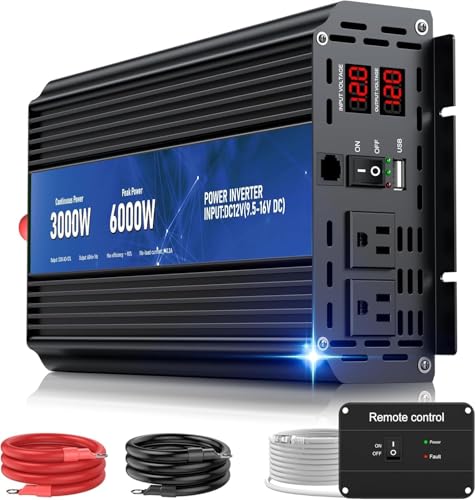 Best for emergency backup3000W Power Inverter 12V DC to 110V/120V AC ConverterView on Amazon
- 7
 Best for high surge loads4000 Watt Power Inverter 12V DC to 120V/110V AC for Vehicles Car ConveView on Amazon
Our Top Picks
| Product | Best for | Key feature |
|---|---|---|
| LANDERPOW 3000W Pure Sine Wave Inverter | Overall RV use | Hardwire port, remote control |
| BELTTT 3000W Pure Sine Wave Inverter | Dual-zone outlets | Two 20A outlets, LCD display |
| BELTTT 2000W Pure Sine Wave Inverter | Mid-size campers | Dual AC outlets, 23 ft remote |
| Vansdon 2000W Pure Sine Wave Inverter | USB-C charging | 30W USB-C port |
| Cantonape 3000W Power Inverter | Four-outlet setups | Four AC outlets, USB ports |
| 3000W Power Inverter 12V to 120V | Emergency backup | Dual outlets, USB port |
| 4000 Watt Power Inverter 12V to 120V | High surge loads | 8000W surge, 200 ft remote |
LANDERPOW 3000W Pure Sine Wave Inverter 12V DC to 120V AC
Power Inverters for Truck, Vehicles, Solar, Off-Grid with 3 AC Outlets, 30W USB-C, 5V/3.1A USB, Hardwire Port, Remote Control 3000W Pure Sine Wave Inverter 12V DC to 120V AC 6000W Peak for RV
Best for: Overall RV use with a hardwire connection.
This model suits campers who want a permanent install with a hardwire port and a range of outlet types for everyday loads.
Pros
- Hardwire port for permanent installation
- Three AC outlets plus USB-C and USB ports
Cons
- Heavier than plug-in models
BELTTT 3000W Pure Sine Wave Inverter 12V DC to 120V AC
LCD Display, 23 ft Wired Remote, Dual AC and 20A Outlets, Hardwire Port, USB, Power Inverter for Solar, Off-Grid, RV, Truck 3000W Pure Sine Wave Inverter 12V DC to 120V AC, 6000W Peak
Best for: Dual-zone outlets and clear status monitoring.
Good for campers running two separate high-draw appliances at once, such as a microwave and a coffee maker.
Pros
- Two 20A outlets for higher-draw loads
- LCD display and 23 ft wired remote
Cons
- Fan noise under heavy load is commonly mentioned
BELTTT 2000W Pure Sine Wave Inverter 12V DC to 120V AC
LCD Display, Dual AC and 20A Outlets, 23ft Remote, Hardwire Port, USB, Power Inverter for Solar, RV Truck, 93% Max Efficiency 2000W Pure Sine Wave Inverter 12V DC to 120V AC, 4000W Surge
Best for: Mid-size campers with moderate power needs.
A sensible choice for travel trailers and vans that run lights, a laptop and a small appliance rather than full-size kitchen equipment.
Pros
- Lower wattage keeps battery draw more manageable
- Dual AC and 20A outlets
Cons
- Limited headroom for large air conditioners
Vansdon 2000W Pure Sine Wave Inverter 12V DC to 120V AC
Vansdon 2000W Pure Sine Wave Inverter 12V DC to 120V AC Inverters for RV,Truck, Solar, Home, Off-Grid, Car Power Inverter with LCD Display, 3 AC Outlet, 30W USB-C, USB, Remote Control, Surge 4000W
Best for: USB-C charging alongside AC loads.
Fits campers who charge modern phones, tablets and laptops directly from the inverter without a separate charger.
Pros
- 30W USB-C port alongside standard USB
- Remote control included
Cons
- Fewer AC outlets than the larger models
Cantonape 3000W Power Inverter 12V to 110V/120V
Cantonape 3000W Power Inverter 12V to 110V/120V DC to AC with LCD Display | Remote Controller 4 x AC Outlets and 4 x 3.1A USB Car Adapter for Car Truck Boat RV Solar System
Best for: Four-outlet setups for multiple devices.
Useful for groups or families who want several devices running without daisy-chaining power strips.
Pros
- Four AC outlets and four USB ports
- LCD display and remote controller
Cons
- Brand support information is less established than larger names
3000W Power Inverter 12V DC to 110V/120V AC Converter
3000W Power Inverter 12V DC to 110V/120V AC Converter, 6000W Peak RV Use | LCD Display & Remote Control, Dual AC Outlets,3.4A USB Port for RV, Truck, Solar System, Emergency Backup, Camping,Off-Grid
Best for: Emergency backup and off-grid camp use.
A practical pick for campers who want a reliable backup source for medical devices, lighting or communications during outages. For a deeper look, 7 Best Power Inverters for RV TV Options for Campers (2026) covers this in detail.
Pros
- 6000W peak rating for brief surges
- LCD display and remote control
Cons
- Dual outlets only, so fewer simultaneous connections
Buying Guide
Continuous Wattage vs. Peak Wattage
Continuous wattage is the load an inverter can run steadily, while peak or surge wattage is the short burst it can handle when a motor starts. Match the continuous rating to the devices you plan to run at the same time, and treat the surge rating as a brief allowance for startup loads like air conditioners or refrigerators, not as usable power.
Add up the wattage of everything you expect to run together, then leave some headroom. Running an inverter close to its limit generates more heat and can shorten its life.
Waveform Quality
All the models in this roundup use a pure sine wave output, which closely matches the power from a household outlet. That matters for sensitive electronics, laptops, medical devices, and anything with a motor or compressor, since modified sine wave units can cause buzzing, overheating, or malfunction in some equipment.
Outlets and Connection Options
Check how many AC outlets you need and whether they are standard household receptacles or heavier-duty 20A outlets for higher-draw appliances. USB ports are handy for charging phones and tablets without a separate adapter, and a hardwire terminal lets you connect the inverter directly to your RV’s battery bank for a permanent install.
Remote Control and Display
A remote control or wired remote lets you switch the inverter on and off from inside the camper, which is useful if the unit is mounted in a battery compartment. An LCD display shows input voltage, output load, and fault status, making it easier to monitor battery draw and spot problems early.
Battery Compatibility and Wiring
Every inverter here runs on 12V DC, but the size of the cables, fuse, and battery bank must match the wattage you plan to draw. Higher-wattage units pull heavy current from the battery, so use cables rated for the load and install a proper fuse or breaker close to the battery terminal. If you are unsure about wiring, have a qualified installer handle a hardwired setup.
FAQ
Can a 12V inverter run a microwave in an RV?
Many microwaves draw well over 1000 watts while cooking, so a 2000W or 3000W inverter can typically handle one if no other large loads are running. Expect your battery to drain quickly, and consider a lithium battery bank for longer runtime.
Do I need a pure sine wave inverter for an RV?
A pure sine wave inverter is the safer choice for most RV use because it works with nearly all electronics and motors. Modified sine wave units are cheaper but can cause problems with sensitive devices and some appliances.
How long will an inverter drain my RV battery?
Runtime depends on battery capacity, the load you run, and the inverter’s efficiency. Higher draws and smaller batteries mean shorter runtime, so calculate your expected usage in amp-hours before relying on an inverter for extended periods.
Should I hardwire an inverter or use a plug-in unit?
Plug-in units with a cigarette-style or clamp connection are easy to set up for occasional use. A hardwired installation is better for permanent or high-wattage setups because it uses heavier cabling and a proper fuse, which reduces the risk of overheating.
Do I need to keep the engine running while using an inverter?
Not always, but running the inverter off a starting battery with the engine off can drain it and leave you stranded. If you plan to use significant power while parked, a dedicated house battery bank with a solar charger or a generator is a more reliable option.
Conclusion
If you need a large amount of power for heavier appliances and a permanent setup, the 3000W models with hardwire ports and remote control are the strongest fit. Campers with lighter needs, such as charging devices and running a small appliance, will find a 2000W unit more than capable and easier on the battery.
Related reading
- What Does a Power Inverter Do on an RV? A Plain-English Guide
- Top 5 RV Power Inverter Transfer Switch Options for Campers in 2026
- RV Power Inverter Wiring Diagram (2026): Hardwired vs Plug-In Setup
- RV Power Inverter Troubleshooting: 6 Fixes for Common Faults (2026)
About Colin Foster
Colin Foster is part of our editorial team and reviews and edits our off-grid power for camping, RV & vanlife guides, checking product details against manufacturer specifications and owner feedback.