 By Lauren Holland
Updated November 2026
How much power does an RV air conditioner use? Most rooftop units draw roughly 1,300 to 1,500 watts while running, but they can spike to several times that for a moment when the compressor starts. This guide shows you how to find your unit’s real numbers, convert them into amps and hours of runtime, and decide whether your battery, inverter or shore power can handle it. How Much Solar Power Do I Need for RV: A Step-by-Step Sizing Guide goes further into this.
Step 1: Find the Nameplate Rating on Your Unit
Start with the data plate on the AC unit itself, usually on the side or inside the access panel. Look for the running watts or amps, the voltage (typically 115V AC) and the LRA or locked rotor amps, which is the startup current. Manufacturers specify these values, and they are the most reliable starting point. If you can only find a BTU rating, a common 13,500 BTU unit is generally in the 1,300 to 1,500 watt running range, but treat that as an estimate.
Shopping for one? See our guide: 4 Best RV Solar Power Air Conditioners for Off-Grid Camping in 2026.
Step 2: Convert Watts and Amps Into a Usable Load
Amps and watts are linked by voltage. At 115V, a 12-amp running draw works out to about 1,380 watts. Use the running figure for steady operation and plan for the startup surge separately. Startup current (LRA) can be five to seven times the running current for a split second, which is why an undersized inverter may shut down when the AC tries to start.
Step 3: Estimate Runtime on Your Power Source
Once you know the running watts, estimate how long your battery or power station can carry the load. Divide the usable watt-hours of your power source by the AC’s running watts, then account for inverter losses, which commonly run 10 to 15 percent.
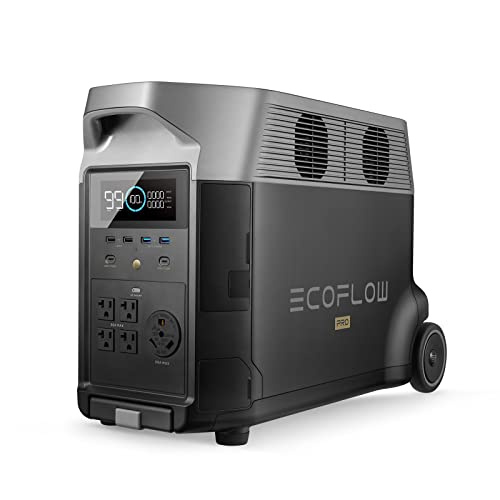
- Example: A 2,000 watt-hour power station, with about 1,500 usable after losses, running a 1,400 watt AC gives roughly one hour of continuous cooling.
- Lithium vs. lead-acid: Lithium lets you use most of the rated capacity. Lead-acid should only be discharged to about half, so its real runtime is shorter.
- Thermostat cycling: The compressor does not run constantly. Real-world consumption depends on how often it cycles, which is why runtime estimates should be treated as a range.
Step 4: Match the AC to Your Power Setup
Your power source must handle both the running load and the startup surge. Shore power at a campground is usually the simplest option, since a 30 amp hookup provides about 3,600 watts, enough for one AC plus other loads if you manage them. Off-grid, a dedicated inverter and a battery bank sized for hours of runtime are required. For sizing details, see Power Inverter for RV Air Conditioner: How to Size It and Run It (2026). For the power draw breakdown in more depth, read RV AC Power Draw: How Many Watts Your Air Conditioner Really Uses.
| Setup | Typical Ceiling for One AC | Main Limit |
|---|---|---|
| 30 amp shore power | About 3,600 watts | Shared with other loads |
| 50 amp shore power | About 12,000 watts | Breaker and wiring condition |
| Battery and inverter | Depends on inverter size | Startup surge and battery capacity |
Solar Changes the Math
Solar can offset AC use during the day, but a single panel rarely covers a rooftop unit on its own. For realistic panel counts, see Solar Power for RV Air Conditioning: How Many Panels You Really Need.
Common Mistakes
- Using the BTU rating as a watt figure instead of checking the nameplate.
- Ignoring the startup surge when choosing an inverter.
- Assuming a 30 amp plug can run an AC plus a microwave and heater at once.
- Forgetting that inverter efficiency reduces usable battery capacity.
- Skipping surge protection on shore power, which can damage AC electronics. See RV Power Surge Protection: How to Choose and Install One Safely.
Recommended Gear
- A plug-in watt meter helps you measure real consumption on shore power before you commit to a setup. View on Amazon
- A surge protector rated for RV use guards the AC against voltage spikes at the campground pedestal. View on Amazon
FAQ
How much power does an RV air conditioner use on average?
A typical rooftop unit draws about 1,300 to 1,500 running watts, but the exact figure depends on the model. Check the nameplate on your unit for the official rating.
Can I run an RV air conditioner on a portable power station?
Yes, if the station’s inverter can handle the running watts and startup surge, and its battery capacity covers the hours you need. Many owners find runtime is limited to an hour or two on a mid-sized station.
Why does my RV AC trip the breaker when it starts?
The startup surge can be several times the running current, which can overload a shared circuit or undersized inverter. Reducing other loads or upgrading to a higher capacity source usually solves it. Consult a qualified RV technician or electrician if breakers trip repeatedly.
Conclusion
To answer how much power does an RV air conditioner use, check the nameplate, plan for both running watts and startup surge, and estimate runtime with inverter losses included. With those numbers, you can decide whether shore power, a battery bank or solar makes the most sense for your trip.
Ready to choose one?
About Lauren Holland
Lauren Holland is part of our editorial team and reviews and edits our off-grid power for camping, RV & vanlife guides, checking product details against manufacturer specifications and owner feedback.