
 By Lauren Holland
Updated November 2026
Running an air conditioner off the grid is one of the hardest jobs you can ask of a camper power system, and choosing the right solar power AC for RV setup starts with knowing what your rig actually needs. This guide compares six portable power stations with solar panels that can run RV air conditioning, judged on continuous AC output, surge capacity, battery size, solar input, expandability and how well each one fits typical camping use. Owners of these systems frequently report that the real limit is battery capacity and sun hours, not the wattage printed on the box.
Our top picks at a glance
- 1
 TOP CHOICEBest overallJackery HomePower 3600 Plus & 2x200W Solar Panels, 3584Wh, 3600W AC OutputView on Amazon
- 2
 TOP CHOICEBest for expandable backupJackery HomePower 3000 and 2x200W Solar Panels, 3072Wh, 3600W AC OutputView on Amazon
- 3
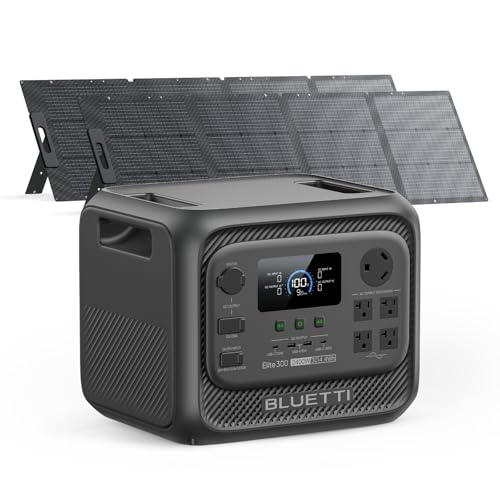 TOP CHOICEBest for a compact high-output unitBLUETTI Solar Generator Elite 300 & 2x200W Solar Panel 3014.4Wh LFP BatteryView on Amazon
- 4
 Best for light loadsPortable Solar Generator 300W Portable Power Station with 60W Solar Panel, 280WhView on Amazon
- 5
 Best budget pickPortable Power Station with 40W Solar Panel, 100W Solar Powered Generator, 146WhView on Amazon
- 6
 Best for RV hookup flexibilityABOK Ark3600 Portable Power Station with 3×200W Solar Panels, 3840Wh 3600WView on Amazon
Selection criteria: continuous AC output versus the surge needed to start a compressor, usable battery watt-hours, solar input per day, RV-specific outlets such as TT-30 or 12V ports, expandability, and owner feedback patterns on reliability and charging speed. No product here was tested in a lab by us; the comparison is based on manufacturer specifications and recurring themes in owner reports.
Our Top Picks
Quick Comparison
| Product | Best for | Key feature |
|---|---|---|
| Jackery HomePower 3600 Plus & 2x200W Solar Panels | Full-size RV AC with solar backup | 3584Wh battery, 3600W AC output |
| Jackery HomePower 3000 and 2x200W Solar Panels | Expandable home-style backup | 3072Wh battery, 7200W surge |
| BLUETTI Solar Generator Elite 300 & 2x200W Solar Panel | Compact high-output setups | 3014.4Wh LFP battery, TT-30 RV port |
| Portable Solar Generator 300W Portable Power Station with 60W Solar Panel | Light loads and fans | 280Wh battery, pure sine wave |
| Portable Power Station with 40W Solar Panel, 100W Solar Powered Generator | Budget small-load camping | 146Wh battery, small solar input |
| ABOK Ark3600 Portable Power Station with 3×200W Solar Panels | RV plug-in and solar combined | 3840Wh battery, TT-30 RV port |
Jackery HomePower 3600 Plus & 2x200W Solar Panels, 3584Wh, 3600W AC Output
Jackery HomePower 3600 Plus & 2x200W Solar Panels, 3584Wh, 3600W AC Output | LFP Battery, Expandable to 21kWh, Solar Generator, Essential Home Backup for Home Use, Emergencies, RV
Best for: Full-size RV AC with solar backup
This is a fit for campers who want the most conventional whole-rig approach: a large battery, substantial AC output and paired solar panels, with the option to add capacity later. It suits people running a rooftop-style RV air conditioner for several hours a day in mild conditions.
Key specs
- Battery capacity: 3584Wh (per listing)
- Continuous AC output: 3600W (per listing)
- Battery chemistry: LFP (lithium iron phosphate)
- Included solar panels: 2x200W
Pros
- Large battery reserve for multi-hour AC runtime
- LFP chemistry is generally associated with long cycle life
- Expandable capacity for longer off-grid stays
Cons
- Heavy and bulky to move between campsites
- Full recharge from solar takes a full sunny day or more
Bottom line: Best for campers who run AC daily and want the biggest battery margin without jumping to a multi-unit system.
View on AmazonJackery HomePower 3000 and 2x200W Solar Panels, 3072Wh, 3600W AC Output
Jackery HomePower 3000 and 2x200W Solar Panels, 3072Wh, 3600W AC Output | 7200W Surge, LFP Battery, Solar Generator, Essential Backup for Home Use, Power Outage, RV, Emergencies
Best for: Expandable home-style backup
A close relative of the 3600 Plus with a slightly smaller battery. It fits campers who want similar output and solar pairing at a somewhat lower capacity point, and who may also use it for home backup between trips.
Key specs
- Battery capacity: 3072Wh (per listing)
- AC output: 3600W continuous, 7200W surge (per listing)
- Battery chemistry: LFP
- Included solar panels: 2x200W
Pros
- Surge rating helps with compressor startup
- Good balance of capacity and portability for its class
- Works for both camping and emergency backup
Cons
- Less stored energy than the larger model for long AC runs
- Still heavy enough to need two people for loading
Bottom line: A sensible choice for campers who want strong surge handling and a slightly lighter, lower-capacity unit than the top model.
View on AmazonBLUETTI Solar Generator Elite 300 & 2x200W Solar Panel 3014.4Wh LFP Battery
BLUETTI Solar Generator Elite 300 & 2x200W Solar Panel 3014.4Wh LFP Battery | w/ 2400W AC Outlets (4800W Surge), Smallest 3kWh, Portable Power Station for RV, Home Backup, w/ TT-30 RV Port & 12V/30A D
Best for: Compact high-output setups
This unit is aimed at campers who want high AC output and a dedicated RV-style 30-amp port in a relatively compact footprint. It suits people who value a tidy setup and plan to connect to shore power when it is available.
Key specs
- Battery capacity: 3014.4Wh LFP (per listing)
- AC output: 2400W continuous, 4800W surge (per listing)
- RV port: TT-30 and 12V/30A DC output (per listing)
- Included solar panels: 2x200W
Pros
- Strong surge rating for startup loads
- Built-in TT-30 port simplifies RV connection
- Compact for its capacity class
Cons
- Continuous output is lower than the Jackery 3600-class units
- Limited headroom if your AC draws near the rated continuous load
Bottom line: Good for campers who want an RV-ready port and solid surge margin in a smaller package, provided their AC fits within 2400W.
View on AmazonPortable Solar Generator 300W Portable Power Station with 60W Solar Panel, 280Wh
Portable Solar Generator 300W Portable Power Station with 60W Solar Panel | 110V Pure Sine Wave 280Wh Battery Solar Power Pack with USB QC3.0 DC AC Outlet for Camping Smart Device RV Van Outdoor-Orang
Best for: Light loads and fans
A small unit suited to campers whose main electrical needs are phone charging, LED lights, a fan and perhaps a small cooler. It is not a realistic primary source for a conventional RV air conditioner.
Key specs
- Battery capacity: 280Wh (per listing)
- AC output: 300W class (per listing)
- Waveform: pure sine wave (per listing)
- Included solar panel: 60W
Pros
- Light and easy to carry
- Pure sine wave output is suitable for sensitive electronics
- Low-cost entry into solar camping power
Cons
- Far too little capacity for running an RV air conditioner
- 60W panel recharges slowly under average sun
Bottom line: Pick this only if your cooling needs are a fan rather than real AC; it will not carry a compressor.
View on AmazonPortable Power Station with 40W Solar Panel, 100W Solar Powered Generator, 146Wh
Portable Power Station with 40W Solar Panel, 100W Solar Powered Generator | Portable AC Outlet Camping Solar Power Bank 146Wh DC Battery Pack for Smart Device RV Outdoor Power Outage with Solar Charge
Best for: Budget small-load camping
This is the smallest option here and a budget pick for campers who want a basic solar-charged power bank for devices and minor loads. It is not sized for air conditioning.
Key specs
- Battery capacity: 146Wh (per listing)
- AC output: 100W class (per listing)
- Included solar panel: 40W (per listing)
Pros
- Very portable and simple to set up
- Useful as a backup for phones and small electronics
- Budget-friendly entry point
Cons
- Capacity is too small for any meaningful AC runtime
- Small solar input means slow recharging
Bottom line: Suitable for device charging and emergency lighting, not for powering an RV air conditioner.
View on AmazonABOK Ark3600 Portable Power Station with 3×200W Solar Panels, 3840Wh 3600W
ABOK Ark3600 Portable Power Station with 3×200W Solar Panels, 3840Wh 3600W | 2H Fast Charge, 15 Ports, TT-30 RV Port, Expandable to 11520Wh, Solar Generator for Home Backup, RV, Camping
Best for: RV plug-in and solar combined
This model pairs a large battery with three solar panels and a TT-30 RV port, which suits campers who alternate between shore power and off-grid sites and want one unit that handles both.
Key specs
- Battery capacity: 3840Wh (per listing)
- AC output: 3600W class (per listing)
- RV port: TT-30 (per listing)
- Included solar panels: 3x200W (per listing)
Pros
- Three-panel solar input speeds daily recharge
- TT-30 port for direct RV connection
- Large battery reserve for AC runs
Cons
- Three panels take more space to deploy
- Heavy system to set up and stow at each site
Bottom line: A strong fit for campers who want the most solar input in this list and a built-in RV port for flexible site use.
View on AmazonBuying Guide
Continuous AC output and surge rating
Check the continuous wattage against your AC’s running draw, and the surge rating against its startup draw. Compressor startup can briefly exceed the running figure several times over. Look for surge capacity at least comparable to the air conditioner’s startup demand.
Good picks for this: Jackery HomePower 3000 and BLUETTI Solar Generator Elite 300
Usable battery capacity in watt-hours
Watt-hours tell you how long a load can run. A rough estimate is watt-hours divided by the load in watts. Real output is lower after conversion losses, so plan with a margin.
Good picks for this: Jackery HomePower 3600 Plus and ABOK Ark3600
Solar input and daily recharge
Panel wattage and local sun hours determine how much you can replace each day. Owners often report that a single small panel is only enough to top off devices, while multi-panel setups are needed to keep up with AC use. Panel count and roof or ground space matter.
Good picks for this: ABOK Ark3600 and Jackery HomePower 3600 Plus
RV-specific outlets and connections
A TT-30 port or 12V/30A output can simplify connecting to an RV’s wiring. Confirm the port matches your rig and that your AC will not overload the circuit.
Good picks for this: BLUETTI Solar Generator Elite 300 and ABOK Ark3600
Battery chemistry and lifespan
LFP batteries are widely associated with longer cycle life than some other lithium chemistries, which matters for systems you cycle every day. Check the stated chemistry on the listing.
Good picks for this: Jackery HomePower 3600 Plus and Jackery HomePower 3000
Portability and setup effort
Large units with multiple panels are heavy and take time to deploy. If you move every night, a lighter unit may be more practical, even if it means less capacity.
Good picks for this: Portable Solar Generator 300W and Portable Power Station with 40W Solar Panel
Expandability and future needs
Some systems accept additional battery modules or panels. If you expect to run AC more often over time, expandability can be worth more than the starting capacity.
Good picks for this: Jackery HomePower 3000 and ABOK Ark3600
FAQ
Can a solar generator run an RV air conditioner?
Some large units can, but only for limited periods unless you have substantial battery capacity and solar input. A typical RV air conditioner draws several hundred to over a thousand watts while running, so runtime depends on battery size and conditions.
How many solar panels do I need to run an RV AC?
It depends on the AC’s power draw, how many hours you run it, and local sun. Owners frequently report needing more panels than they expected. A detailed walk-through is available in Solar Power for RV Air Conditioning: How Many Panels You Really Need.
What is the difference between continuous and surge watts?
Continuous watts are the steady load a unit can supply. Surge watts are the short burst it can handle at startup. Compressors need surge capacity to start. For a deeper explanation, see Power Station AC Output Explained: Watts, Surge and Outlets.
Do I need a power inverter for an RV air conditioner?
Many portable power stations include built-in AC inverters, so a separate unit is often unnecessary. If you are building a fixed system, the sizing considerations differ. See Power Inverter for RV Air Conditioner: How to Size It and Run It (2026).
Is LFP battery chemistry better for RV use?
LFP is generally associated with longer cycle life and stable performance, which suits daily cycling. It is heavier per watt-hour than some alternatives, so there is a trade-off with portability.
How do I size a solar system for camping power?
Start with your daily watt-hour use, add margin for losses, then divide by local peak sun hours to estimate panel wattage. A broader overview is in RV Solar Power Basics: Panels, Controllers and Batteries.
Can I charge a solar power station from shore power?
Many units accept AC charging as well as solar. This is useful on cloudy days or when parked at a campground with hookups. For connection options, see Using a Portable Power Station in an RV or Camper Van.
Conclusion
For most campers who want to run an RV air conditioner off solar, the larger units with at least 3000Wh of battery and substantial surge capacity are the realistic starting point. The Jackery HomePower 3600 Plus suits those wanting the most conventional whole-rig approach, while the Jackery HomePower 3000 fits campers who prioritize surge handling. The BLUETTI Solar Generator Elite 300 works for compact setups with a built-in RV port, and the ABOK Ark3600 suits people who want the most solar input and TT-30 flexibility. The two smaller units are better matched to fans, lights and device charging than to any real AC load. Confirm your air conditioner’s running and startup draw before choosing, and remember that sun hours will ultimately decide how long your system keeps cooling you.
Sources
- Federal guidance on battery storage, solar energy basics and sizing considerations for home and portable systems (energy.gov)
- Consumer safety information on portable power equipment, batteries and electrical hazards (cpsc.gov)
- Research and data on solar resource, photovoltaic performance and battery technology (nrel.gov)
About Lauren Holland
Lauren Holland is part of our editorial team and reviews and edits our off-grid power for camping, RV & vanlife guides, checking product details against manufacturer specifications and owner feedback.






