
 By Lauren Holland
Updated November 2026
Shopping for the best DC to AC power inverter for car use usually comes down to one question: will it run what you plan to plug in? A small inverter can charge phones and power a laptop, while a larger unit may be needed for a coffee maker or a small fan. This list compares seven models sold on Amazon US, grouped by the wattage and features that matter most at a campsite or on a road trip. The criteria were manufacturer-listed continuous wattage, outlet and USB configuration, housing and cooling design, and patterns owners commonly mention in feedback, including fan noise, fuse behavior and how well the unit fits a cigarette lighter socket.
Our top picks at a glance
- 1
 TOP CHOICEBest overallBESTEK Power Inverter 300WView on Amazon
- 2
 TOP CHOICEBest for high-draw gearPro Chaser 400W Power Inverters for VehiclesView on Amazon
- 3
 TOP CHOICEBest for laptops and camp electronicsPiSFAU 200W Car Power InverterView on Amazon
- 4
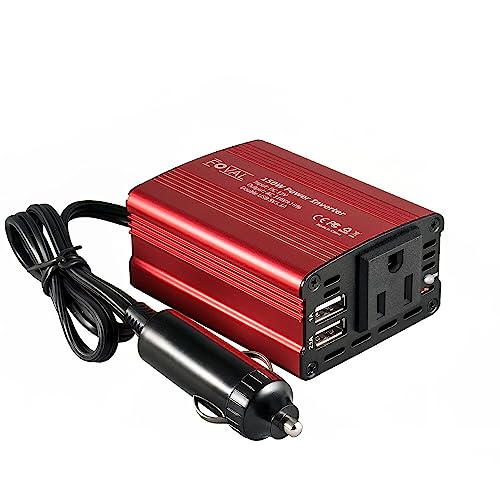 Best budget pickFOVAL 150W Car Power InverterView on Amazon
- 5
 Best for larger loads1000W Power Inverter 12V DC to 110V/120V AC Car ConverterView on Amazon
- 6
 Best for a simple 400W setupVANSOET 400W Power Inverter for Vehicles 12V to 110VView on Amazon
- 7
 Best mid-range with display500W Power Inverter 12V DC to 110V/120V AC Car ConverterView on Amazon
Our Top Picks
| Product | Best for | Key feature |
|---|---|---|
| BESTEK Power Inverter 300W | Phones, tablets and a small laptop | Dual 4.8A USB charging ports |
| Pro Chaser 400W Power Inverter | Laptops and a small air compressor | Dual AC adapters and 6.2A dual USB |
| PiSFAU 200W Car Power Inverter | Camp electronics and road trip gear | Dual AC outlets with USB-A and USB-C |
| FOVAL 150W Car Power Inverter | Light single-device use | Compact classic design with 3.1A dual USB |
| 1000W Power Inverter 12V to 110V/120V | Heavier loads and home-style appliances | LCD display with 36W Type-C port |
| VANSOET 400W Power Inverter | Simple 400W needs at camp | Straightforward 400W 12V to 110V output |
| 500W Power Inverter 12V to 110V/120V | Mid-range loads with monitoring | LCD screen and 2 AC outlets |
BESTEK Power Inverter 300W
BESTEK Power Inverter DC 12-17V to AC 110V – 300W Car Plug Adapter Outlet | 4.8A Dual USB Fast Charging Port, Vehicle Charger Cigarette Lighter Adapter for Phone, Laptop on Road Trip – Aluminum Housin
Best for: Phones, tablets and a small laptop
This is a good fit for someone who mainly needs to keep devices charged on a road trip or at a basic campsite and does not plan to run anything with a heating element.
Key specs:
- Input: 12V DC from a vehicle cigarette lighter socket
- Output: 110V AC, 300W rated
- Dual USB charging ports at 4.8A total
- Aluminum housing
Pros:
- Aluminum housing helps with heat dissipation
- Dual USB ports cover phones and tablets
- Simple plug-in setup
Cons:
- Not suited to continuous high-wattage loads
- Limited headroom for startup surges
Bottom line: A sensible pick for charging devices and running low-draw electronics. Choose it if 300W is more than enough for your setup.
View on AmazonPro Chaser 400W Power Inverters for Vehicles
Pro Chaser 400W Power Inverters for Vehicles DC 12v to AC 110v Car Inverter | Car Converter, 6.2A Dual USB Charging Ports, Dual AC Adapter for Laptops Air Compressor
Best for: Laptops and a small air compressor
Suits campers who want a bit more headroom than a 300W unit and need two AC adapters for laptops or compact tools.
Key specs:
- Output: 400W rated, 12V DC to 110V AC
- Dual USB charging ports at 6.2A total
- Dual AC adapter outputs
Pros:
- More capacity than entry-level 300W units
- Two AC outlets for multiple small devices
- Higher USB output for faster charging
Cons:
- Runtime on a starting battery is short under load
- Not designed for heating appliances
Bottom line: A practical upgrade for laptop-plus-accessory setups. Pick it when a 300W unit feels tight.
View on AmazonPiSFAU 200W Car Power Inverter
PiSFAU 200W Car Power Inverter – DC 12V to 110V AC Car Plug Adapter Outlet | Dual AC Outlet 4.8A 24W USB-A/C, Portable Cigarette Lighter Charger for Laptop/Camping/Road Trip Essential/Vehicle Accessor
Best for: Laptops and camp electronics
A lighter-duty option for someone whose loads are mostly electronics and who values having both USB-A and USB-C available.
Key specs:
- Output: 200W rated, 12V DC to 110V AC
- Dual AC outlets
- 4.8A 24W USB-A and USB-C ports
Pros:
- USB-C alongside USB-A covers modern devices
- Compact footprint for a glovebox or console
- Good match for laptop and phone charging
Cons:
- Lower wattage limits what else can run
- Long cables are not included, so placement can be tricky
Bottom line: Best for electronics-only camp setups. Look at a larger unit if you plan to add appliances.
View on AmazonFOVAL 150W Car Power Inverter
FOVAL 150W Car Power Inverter 12V DC to 110V AC Converter Vehicle Adapter Plug Outlet with 3.1A Dual USB Car Charger for Laptop Computer (Classic Red)
Best for: Light single-device use
Aimed at drivers who only need an occasional outlet for a laptop charger or phone and want the lowest-cost route into inverters.
Key specs:
- Output: 150W rated, 12V DC to 110V AC
- Dual USB at 3.1A total
- Compact classic design
Pros:
- Compact and easy to stow
- Simple plug-and-play setup
- Handles basic charging well
Cons:
- Lowest wattage on this list
- USB output is modest for fast charging
Bottom line: A budget pick for light use. Step up if you expect to run anything beyond small electronics.
View on Amazon1000W Power Inverter 12V DC to 110V/120V AC Car Converter
1000W Power Inverter 12V DC to 110V/120V AC Car Converter for Vehicles | LCD Screen Display, 2 AC Outlets, 36W Type-C Port, 5V/3A USB Port, Car Plug Adapter for Truck, Home, Camping, Laptop, Trip
Best for: Heavier loads and home-style appliances
For campers and RV owners who want to run bigger devices and monitor input voltage on an LCD screen.
Key specs:
- Output: 1000W rated, 12V DC to 110V/120V AC
- 2 AC outlets
- 36W Type-C port and 5V/3A USB port
- LCD display
Pros:
- Much higher capacity than the smaller units
- LCD display helps with monitoring
- Type-C port for fast device charging
Cons:
- Heavy draw can drain a starting battery quickly
- Requires heavier gauge wiring for direct battery connections
Bottom line: The right choice when your loads exceed 500W. Run the engine while using it and check your wiring.
View on AmazonVANSOET 400W Power Inverter for Vehicles 12V to 110V
VANSOET 400W Power Inverter for Vehicles 12V to 110V Inverter[Black]
Best for: Simple 400W needs at camp
A no-frills option for someone who wants a straightforward 400W unit without extra features.
Key specs:
- Output: 400W rated, 12V DC to 110V AC
- Black housing
Pros:
- Simple, focused design
- 400W capacity for common small appliances
- Easy to set up and stow
Cons:
- Fewer listed features than some competitors
- Specific port configuration should be checked on the listing
Bottom line: A good match for buyers who want 400W without extras. Confirm the outlet layout before buying.
View on Amazon500W Power Inverter 12V DC to 110V/120V AC Car Converter
500W Power Inverter 12V DC to 110V/120V AC Car Converter for Vehicles | LCD Screen Display, 2 AC Outlets, 36W Type-C Port, 5V/3A USB Port, Car Plug Adapter for Truck, Home, Camping, Laptop, Trip
Best for: Mid-range loads with monitoring
Works for campers who want more capacity than 300W but do not need the full 1000W class.
Key specs:
- Output: 500W rated, 12V DC to 110V/120V AC
- 2 AC outlets
- 36W Type-C port and 5V/3A USB port
- LCD display
Pros:
- Good middle ground between 300W and 1000W
- LCD display for quick checks
- Type-C port supports fast charging
Cons:
- Still not suitable for high-wattage heating
- Battery drain is noticeable under sustained use
Bottom line: A balanced pick for mixed electronics and small appliances. Choose it over the 1000W model if your loads stay under 500W.
View on AmazonBuying Guide
Continuous vs. peak wattage
Manufacturers usually list a continuous rating and sometimes a higher peak or surge figure. Size your inverter to the continuous load of everything running at once. Motors and compressors can draw several times their running wattage at startup, so leave headroom.
Good picks for this: Pro Chaser 400W Power Inverters for Vehicles, 1000W Power Inverter 12V to 110V/120V
Outlets and USB ports
Count how many devices need power at the same time. Dual AC outlets help with multiple small loads, and USB-C ports matter for newer phones and laptops that charge faster through Power Delivery.
Good picks for this: PiSFAU 200W Car Power Inverter, 500W Power Inverter 12V to 110V/120V
Connection and fuse protection
Units that plug into a 12V cigarette lighter socket are convenient for light loads, but the socket is typically fused at a low amperage. Higher-wattage inverters generally need direct battery connections with appropriately sized cable and an inline fuse close to the battery. The U.S. Department of Energy notes that wiring and fuse sizing are central to safe 12V electrical work; consult a qualified automotive electrician if you are unsure.
Good picks for this: BESTEK Power Inverter 300W, FOVAL 150W Car Power Inverter
Cooling and housing
Inverters convert power with some heat loss. Aluminum housings and internal fans help dissipate heat. Make sure the unit has airflow around it and is not wedged in a closed compartment.
Good picks for this: BESTEK Power Inverter 300W, VANSOET 400W Power Inverter for Vehicles
Display and monitoring
An LCD screen can show input voltage and output status, which helps you catch low battery voltage before it becomes a problem. This is useful when running an inverter for extended periods away from a charging source.
Good picks for this: 1000W Power Inverter 12V to 110V/120V, 500W Power Inverter 12V to 110V/120V
Battery drain and runtime
Inverters draw from your starting battery. Run the engine while using high loads, and avoid leaving an inverter on overnight with the engine off. A dedicated auxiliary battery is the common solution for longer camp use.
Good picks for this: 1000W Power Inverter 12V to 110V/120V, Pro Chaser 400W Power Inverters for Vehicles
Size and fit
Compact units are easier to stow but may have less capacity. Measure your storage space and confirm the unit’s cable length reaches your devices without strain.
Good picks for this: FOVAL 150W Car Power Inverter, PiSFAU 200W Car Power Inverter
FAQ
What is the best DC to AC power inverter for car camping?
It depends on your total load. For phones and small electronics, a 150W to 300W unit is usually enough. For laptops plus small appliances, a 400W to 500W unit gives more headroom. Larger loads call for a 1000W model and heavier wiring.
Can I plug a power inverter into the cigarette lighter?
Yes, for low-wattage units. Cigarette lighter sockets are typically fused at a low amperage, so higher-wattage inverters should be wired directly to the battery with appropriately sized cable and a fuse.
Will an inverter drain my car battery?
It can, especially with the engine off. Run the engine while using high loads and avoid leaving the inverter on for long periods without charging.
What is the difference between continuous and peak wattage?
Continuous wattage is the load the inverter can supply over time. Peak or surge wattage is a short-duration figure for startup loads. Size your unit to continuous load with margin for surges.
Do I need a pure sine wave inverter?
Many small electronics run fine on modified sine wave output, but some sensitive devices and motors work better with pure sine wave. Check your device’s requirements before buying.
Is it safe to run a space heater from a car inverter?
Heating appliances draw high wattage and can overload a car electrical system. Most of the units on this list are not designed for heaters. Consult a qualified electrician or refer to manufacturer guidance before running any heating element.
Conclusion
For light electronics, the BESTEK Power Inverter 300W and FOVAL 150W Car Power Inverter cover basic charging needs. The PiSFAU 200W Car Power Inverter suits laptop-and-accessory setups with USB-C. The Pro Chaser 400W Power Inverters for Vehicles and VANSOET 400W Power Inverter for Vehicles give more capacity for small appliances. For heavier loads, the 500W and 1000W Power Inverter 12V to 110V/120V models offer monitoring and higher output. Match wattage to your real continuous load, then plan wiring and battery support around it.
Sources
- Guidance on battery systems, electrical loads and efficiency for home and vehicle power (energy.gov)
- Consumer safety information on electrical product hazards and fire prevention (cpsc.gov)
Related reading
- 6 Best DC AC 300W Car Power Inverters for Camping (2026)
- DC to AC Power Inverter Car: How to Choose, Wire and Use One Safely
- 7 Best Car Battery Inverter AC Power Options for Camping (2026)
- 12V DC to 220V AC Car Power Inverter: Can It Run Your Gear?
- Top 7 Car Power Inverters for TV Options for Road Trips and Camping
- Top 6 Power Inverters for Car to Charge Laptop: Our Picks Compared
- DC Power Inverter for Car: How to Size, Wire and Use One at Camp
- Car Power Inverter 12V to 110V: 3 Best Picks for Camping and Road Trips (2026)
About Lauren Holland
Lauren Holland is part of our editorial team and reviews and edits our off-grid power for camping, RV & vanlife guides, checking product details against manufacturer specifications and owner feedback.





