By Madeline Reed
Choosing a compact power bank for day trips requires balancing size, capacity, and features that match how you use devices outdoors. This guide covers the main factors to consider, from real-world capacity versus rated specs to port types, pass-through charging, size, and cold weather behavior. Whether you are hiking, commuting, or camping, a well-chosen power bank keeps your devices charged without adding bulk. For a selection of options, explore compact power banks.
What It Is and Who It Suits
A compact power bank is a small, portable battery designed to charge USB devices like smartphones, tablets, and wireless earbuds. It suits day trippers who need a lightweight backup for short outings where access to wall outlets is limited. For example, a day hike, a picnic, or a day at the beach are scenarios where a compact power bank provides convenience without the weight of a larger unit. If you are looking for more general information on these devices, see our page on compact power banks.
Main Types and How They Differ
Compact power banks come in several types based on their battery chemistry and features. The most common use lithium-ion or lithium-polymer cells, which offer a good balance of energy density and safety. Some models include solar panels for trickle charging, but for day trips, a standard rechargeable power bank is usually sufficient. Another distinction is the port configuration: some have only USB-A outputs, while others include USB-C with Power Delivery for faster charging of compatible devices. For day trips, a power bank with a single USB-C port may be enough, but having multiple ports can be useful if you need to charge more than one device. The table below summarizes common types for day trips.
| Type | Key Features | Best For |
|---|---|---|
| Standard USB-A | Multiple USB-A ports, widely compatible | Charging older devices or multiple gadgets |
| USB-C with Power Delivery | Fast charging, reversible plug, supports laptops | Newer phones, tablets, and small electronics |
| Solar | Built-in solar panel for trickle charging | Emergency backup or sunny day trips |
Features That Actually Matter
Real Capacity Versus Rated
One of the most important factors is understanding the difference between rated capacity and real usable capacity. The rated capacity, often listed in milliamp-hours (mAh), is based on the internal battery cells at a specific voltage. However, when the power bank boosts the voltage to 5V for USB output, some energy is lost. Additionally, inefficiencies in the charging circuit mean that the actual charge delivered to your device is lower. A common rule of thumb is that usable capacity is about 60-70% of the rated capacity, but this varies by model. For example, a power bank rated at 10,000 mAh might deliver around 6,000-7,000 mAh to your phone. When choosing, look for power banks that provide a typical efficiency figure, but remember that real-world performance depends on factors like temperature and charging speed.
Ports and Connectivity
The ports on a power bank determine which devices you can charge and how quickly. Most compact power banks have at least one USB-A port, which is compatible with a wide range of cables. Increasingly, models include a USB-C port that supports Power Delivery (PD) for faster charging of newer phones and laptops. For day trips, a USB-C port with PD is convenient if your devices support it, as it can reduce charging time. Also, consider the input port for recharging the power bank itself. Many modern power banks use USB-C for both input and output, simplifying cable needs. If you have multiple devices, look for a power bank with enough ports to charge them simultaneously. For more on this, read about USB-C power banks for camping.
Pass-Through Charging
Pass-through charging allows the power bank to charge itself while simultaneously charging connected devices. This feature is useful when you have limited time to charge the power bank before a trip. For example, you can plug the power bank into a wall outlet and connect your phone to it at the same time. However, pass-through charging can generate more heat, which may affect battery longevity. Always check the manufacturer’s instructions to ensure safe use. Some power banks disable pass-through charging when the internal temperature gets too high.
Size and Portability
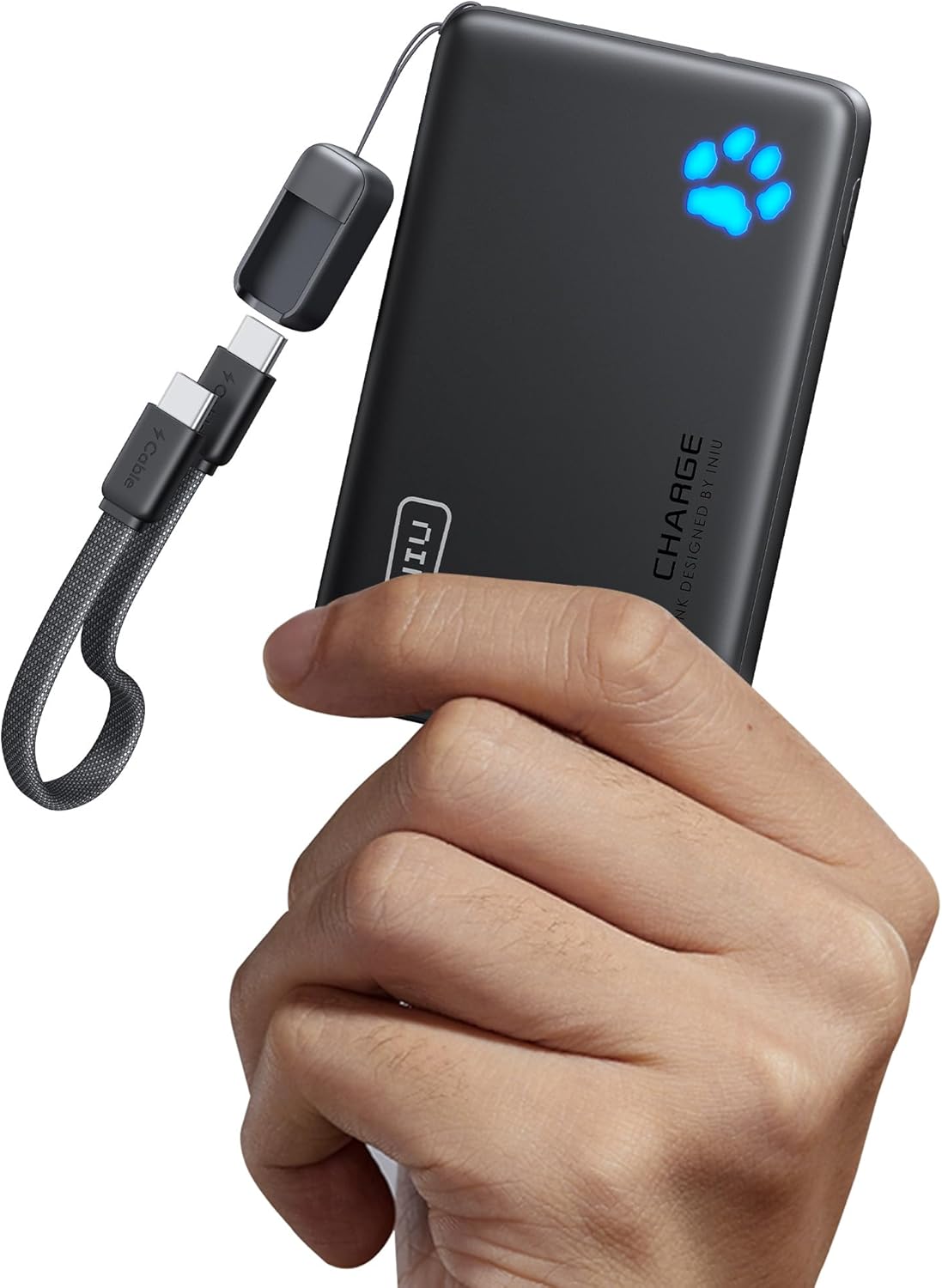
For day trips, size and weight are critical. A compact power bank should fit easily in a pocket or small pouch. Compare the dimensions to common objects like a credit card or a smartphone. Weight is also a factor; lighter is better for carrying all day. Keep in mind that larger capacity often means larger size, so find a balance that suits your needs. For a single device charge, a power bank around the size of a deck of cards may suffice.
Cold Weather Performance
Lithium-based batteries lose capacity in cold temperatures. If you plan to use the power bank in winter or at high altitudes, be aware that its performance may drop. To mitigate this, keep the power bank in an inner pocket close to your body to maintain warmth. Some power banks have built-in low-temperature protection that reduces output to prevent damage. When the power bank warms up, it should return to normal operation. For day trips in cold weather, consider a power bank with a higher rated capacity to account for potential losses.
Sizing, Fit and Compatibility
Choosing the right capacity depends on your devices and usage. For a day trip, you might only need enough power to charge a phone once or twice. Calculate your needs based on your device’s battery capacity. For example, if your phone has a 3,000 mAh battery, a power bank with a rated capacity of 5,000 mAh might provide one full charge after accounting for losses. Also, ensure compatibility with your devices. Check the output voltage and current of the power bank ports against your device’s requirements. Most USB devices are compatible with standard 5V output, but fast charging may require specific protocols like USB-C PD or other fast-charge standards. For broader advice on using power banks outdoors, see power banks for camping.
Common Buying Mistakes
One common mistake is focusing solely on rated capacity without considering real-world efficiency. Another is ignoring port types; for instance, buying a power bank with only USB-A when your phone uses USB-C for fast charging. Overlooking pass-through charging can be a missed convenience for day trips. Also, buying a power bank that is too large or heavy for a day trip defeats the purpose of compactness. Finally, not accounting for cold weather can lead to disappointment when the power bank underperforms in low temperatures.
Care, Cleaning and Upkeep
To extend the life of your compact power bank, store it at a partial charge, around 50%, if not using it for extended periods. Avoid exposing it to extreme heat or cold. Clean the ports gently with a dry brush or compressed air to remove dust. Do not use liquid cleaners. Follow the manufacturer’s instructions for charging and discharging. Most power banks have built-in protection circuits, but it is good practice to use the included cable or a reputable one.
FAQ
How do I know the real capacity of a power bank?
The real capacity is often lower than the rated capacity due to energy loss during voltage conversion. To estimate usable capacity, look for reviews or specifications that mention efficiency. A common rule of thumb is to expect 60-70% of the rated capacity in real-world use. For precise needs, consider a power bank with a higher rated capacity than your device’s battery.
What is pass-through charging and should I use it?
Pass-through charging lets you charge the power bank and your devices at the same time. It is convenient for day trips when you have limited time to charge. However, it can generate heat, so use it sparingly and follow the manufacturer’s guidelines. Some power banks may disable this feature in high temperatures.
Can I use a compact power bank in cold weather?
Yes, but performance may decrease. Lithium batteries lose capacity in cold temperatures. Keep the power bank warm by storing it in an inner pocket. Some models have cold weather protection. If you expect cold conditions, choose a power bank with a higher capacity to compensate for potential losses.
How many ports do I need for a day trip?
For a day trip, one or two ports are usually enough. If you carry multiple devices like a phone and earbuds, a power bank with two ports can charge both simultaneously. Consider the types of ports that match your cables. USB-C is versatile, while USB-A is widely compatible.
Choosing a compact power bank for day trips involves understanding your needs and the key features that affect performance. By focusing on real capacity, ports, pass-through charging, size, and cold weather behavior, you can select a power bank that keeps your devices powered without weighing you down. Always follow the manufacturer’s instructions for safe use and maintenance.

About Madeline Reed
Madeline focuses on practical advice for off-grid power for camping, rv & vanlife: what matters before you buy, what to skip, and how to get more out of what you already own.