By Violet Harlow
When you camp in a vehicle or RV, your battery bank supplies 12V DC power. Many camping devices can run directly on 12V, saving the energy lost when you convert to AC with an inverter. This article explains the key parts of a 12V system: the common sockets and plugs, current limits and fuses, how cable length affects voltage, and which devices are best powered on DC. You will also learn when an inverter is still needed.
Why DC can be more efficient
Every time you convert DC battery power to AC with an inverter, you lose energy. A typical inverter operates at 85–90% efficiency. For example, if you want to run a 100W AC fan, the inverter draws about 110–120W from the battery to cover the conversion loss. That extra power comes from your battery, reducing your available run time.
Many camping devices already run on DC internally. A LED light, a USB phone charger, a fan, or a 12V refrigerator all use low-voltage DC inside. When you feed them AC, the device first converts AC back to DC, wasting energy twice. By running them directly on 12V, you avoid both conversions and get more usable power from each amp-hour of battery capacity.
For a typical camping setup, switching from AC to DC can reduce battery drain by 10–20% on the same devices. That difference adds up over a multi-day trip, especially if you rely on solar charging or a limited battery bank.
Common 12V connectors
You will encounter several types of 12V connectors while camping. Each has a different current capacity and is suited for different loads.
Car accessory socket (cigarette lighter)
This is the round socket found in most vehicles. It is designed for a center-positive plug. The continuous current rating is typically 10A, though some heavy-duty sockets can handle 15A. Many plug-in devices (fans, chargers, coolers) use this connector. The downside is that the spring-loaded contacts can loosen over time, causing intermittent connections and voltage drops. For permanent or high-current installations, a more robust connector is better.
Anderson-style connectors
Anderson connectors (often called SB50, SB175, etc.) are rectangular, color-coded, and lock together. They are common in RV and off-grid setups because they can handle high currents—50A, 100A, or more depending on the size. They are polarity-keyed, so you cannot plug them in backward. Use these for wiring a 12V fridge directly to the battery, for solar panel connections, or for high-current loads like a DC-DC charger. They are more reliable than car sockets for permanent circuits.
5.5 mm barrel connectors
These are small cylindrical plugs with a center pin. They are common on LED light strips, small fans, and portable electronics. The outer sleeve is negative, and the center pin is positive. Two common sizes exist: 2.1 mm and 2.5 mm inner pin diameter. Check your device’s plug size before buying adapters. Barrel connectors are typically rated for 2–5A, so they are not suitable for high-power devices.
Other connectors
You may also see SAE connectors (two-pin plugs common on solar panels and battery maintainers), terminal blocks (for hardwiring), or Powerpole connectors (similar to Anderson but smaller). For most camping needs, the car socket and Anderson are the main ones you will work with.
Current limits and fuses
Every 12V socket and wire has a maximum current it can safely carry. Exceeding that limit can melt insulation, damage connectors, or cause a fire. Always check the rating of the socket you are using and the current draw of your device.
Socket ratings
- Car accessory socket: typically 10A continuous (some up to 15A). Check your vehicle’s owner manual.
- Anderson SB50: rated for 50A continuous.
- Barrel connector (5.5 mm): usually 2–5A, depending on wire gauge and build quality.
Fusing
Every 12V circuit should be protected by a fuse or circuit breaker. The fuse rating should be slightly higher than the device’s normal current draw but lower than the wire’s ampacity. For example, a 12V fridge that draws 5A average (with occasional 10A spikes on compressor startup) should be on a 10A or 15A fuse. If you add a new socket, use a fuse holder near the battery and size the wire to match the fuse.
Never replace a fuse with a higher rating than specified. If a fuse blows repeatedly, the circuit likely has a short or the device is drawing too much current. Check the device and wiring before replacing the fuse.
Cable length and voltage drop
DC power loses voltage as it travels through wire. The longer the cable and the higher the current, the more voltage drops. A drop of 0.5V or more can cause lights to dim, fans to run slower, or a fridge compressor to struggle. To keep voltage drop under control, use thicker wire (lower AWG number) for longer runs.
How voltage drop works
Voltage drop depends on the round-trip length of the wire (positive and negative combined), the current, and the wire’s resistance per foot. For 12V systems, a common rule of thumb is to keep the drop below 3% (about 0.36V).
Example: You want to run a 10A load 20 feet from the battery (40 feet round trip). Using 14 AWG wire, the resistance is about 0.0025 ohms per foot. Voltage drop = 40 ft × 10A × 0.0025 = 1.0V. That is over 8% drop—too high. Switching to 12 AWG (0.0016 ohms/ft) gives 40 × 10 × 0.0016 = 0.64V, still above 3%. For that distance, 10 AWG (0.0010 ohms/ft) yields 0.4V, which is acceptable.
Practical guidance
- For short runs (under 6 feet) with loads under 10A, 14 AWG is usually fine.
- For longer runs or higher currents (e.g., a 12V fridge 15 feet from the battery), use 12 AWG or 10 AWG.
- When buying 12V extension cords, check the wire gauge. Many inexpensive cords use thin wire (18 AWG) that causes significant voltage drop over even a few feet.
- If you are wiring a permanent circuit, use a voltage drop calculator online (enter length, current, and target voltage) to choose the right wire size.
Devices that run well on 12V
Many camping devices are available in 12V versions. Running them on DC saves inverter losses and simplifies your system. Here are common examples:
- LED lights – 12V LED strips or bulbs are very efficient. A 10W LED strip draws about 0.8A. Running it 6 hours uses about 4.8Ah from your battery.
- USB chargers – A 12V-to-USB adapter charges phones, tablets, and power banks at 90%+ efficiency. Avoid using an inverter just to plug in a USB wall charger.
- 12V fans – A typical fan draws 2–3A (24–36W). Running it overnight (8 hours) uses 16–24Ah. That is manageable with a moderate battery bank.
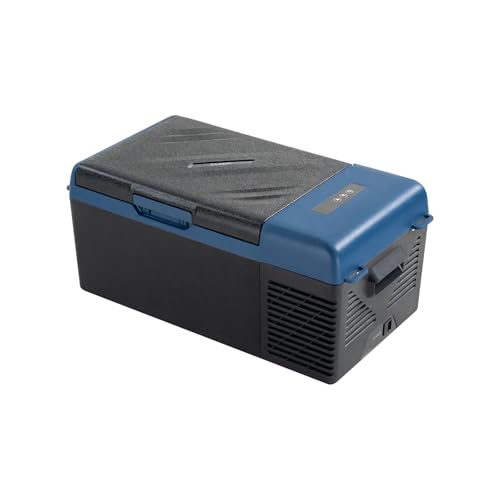
- 12V refrigerators – These are designed for camping and use a compressor. Average draw is 3–7A when running, but they cycle on and off. Over a day, a fridge may use 30–50Ah. For more details, see our guide on running a 12V fridge while camping.
- Laptops and CPAP machines – Many can be powered via a DC-DC converter that plugs into a car socket. These converters are more efficient than running a laptop power supply on AC.
- Water pumps – 12V pumps are standard in RVs for faucets and showers.
By choosing DC versions of these devices, you keep your power system simpler and more efficient. You can also charge your battery bank from your vehicle’s alternator while driving—read more in charging from your car while camping.
When you still need AC
Despite the advantages of DC, some devices are only available in AC or require high power that is impractical on 12V. Examples include:
- Microwaves – A microwave sold as 700W (its cooking power) usually draws 1,000W or more from the outlet, which works out to roughly 100A from a 12V battery through an inverter. That would drain a 100Ah battery in well under an hour. For occasional use, a generator or a large battery bank with a pure sine wave inverter is needed.
- Hair dryers and induction cooktops – These are high-power AC devices (1000–1800W). Running them on 12V requires very thick cables and a large inverter. Most campers use propane or other fuels for cooking and skip these.
- Power tools – Many corded tools require 120V AC. Battery-powered tools (18V, 20V) are a better option for camping.
- Some medical equipment – CPAP machines often have 12V adapters, but other devices may require pure sine wave AC. Check the manufacturer’s specifications.
If you need AC, choose an inverter size that matches your largest load. See what size inverter do you need for camping for guidance. Remember that inverter efficiency losses mean you need more battery capacity than the AC wattage suggests.
FAQ
Can I run a 12V fridge from the car accessory socket?
Yes, if the fridge’s running current is within the socket’s rating (typically 10A). Many 12V fridges draw 5–7A while running, but the compressor startup surge can be higher. Check the fridge’s specifications and your vehicle’s socket fuse. For a permanent installation, it is safer to wire the fridge directly to the battery with an Anderson connector and an inline fuse.
What gauge wire should I use for a 12V extension cord?
It depends on the length and the current. As a rough guide, a 10A load 10 feet away needs 12 AWG to stay near a 3% drop, and longer runs or higher currents call for 10 AWG or thicker. A voltage drop calculator will give you a precise recommendation. When buying pre-made 12V extension cords, look for at least 14 AWG for general use.
Is it safe to daisy chain multiple 12V sockets?
Not recommended unless each socket is on its own fused circuit. If you plug multiple high-current devices into a daisy-chained string, the total current may exceed the wire and fuse rating of the first socket. It is better to run separate fused circuits from a distribution panel or use a single high-current Anderson connector.
Do I need a special plug for my 12V device if it came with a car plug?
If the device already has a car accessory plug, you can use it directly in a car socket. For a more permanent connection, you can cut off the plug and hardwire the device with an Anderson connector or terminal block. Make sure to observe polarity (center positive for car sockets). If the device uses a barrel plug, you can buy an adapter to connect it to a car socket or to a dedicated 12V circuit.
Understanding 12V power basics helps you build a reliable and efficient camping electrical system. By choosing DC devices, using the right connectors and wire sizes, and protecting circuits with fuses, you will get the most from your battery bank and enjoy longer trips without worrying about power loss. Whether you are adding a 12V fridge, upgrading your lighting, or wiring a new socket, these principles will keep your setup safe and effective.

About Violet Harlow
Violet has been writing about off-grid power for camping, rv & vanlife for this site, with an eye on clear explanations, honest trade-offs and options for different needs and budgets.